
Invitation to Courageous Pragmatism
Seven years ago, I had the distinct honor of co-chairing a task force assembled by our state’s governor to “address the ‘persistent crisis’ of housing affordability and accessibility.” The task force was committed to ensuring that our final recommendations reflected input from as many people and regions across our state as possible. As someone who had studied community economic development and worked on the issue of affordable housing, I thought I had a pretty good handle on what the issues were. I learned through the process however, that in some parts of our state, reliable access to safe homes affordable to folks of various income levels was a greater challenge than what we saw in more urban communities. And, the reasons behind the housing challenges varied by region.
My appreciation for regional policy nuances was deepened by traveling across the state, listening to the locals share their housing stories. One of these listening sessions stands out from the rest though, and serves as an awesome case study in civic polarization. The task force hosted a listening session in a region experiencing significant demographic change. A newer influx of immigrants to this community prompted a rise in the expression of xenophobic sentiments and civil rights violations–so much so that our state established a satellite office for its Human Rights department. We were informed that a coalition of community members deeply concerned about the changes they were seeing in their region had organized turnout for this session, and attendance was phenomenal!
Prior to breakout discussions with residents, the task force hosted a panel discussion featuring local funders and the largest employer in the region. The picture painted was one of nuance. The employer, a major healthcare provider, noted challenges finding enough employees to fill critical roles and the impact that had on access to quality care. Local funders underscored that an insufficient supply of homes affordable to folks at a range of income levels, coupled with a rapidly aging population, posed significant obstacles to their goals of long-term viability for the region. After the panel, we broke up into small groups that were designed to capture input on the main points the task force’s final recommendations would address.
Fault Lines
It didn’t take long for fault lines among neighbors to become clear. Chief among the concerns offered by the group that had organized turnout, were being told what to do by folks at the capitol who were perceived to be out of touch with things where they lived, along with the fear of becoming a “nanny state.” In fact, any attempt to capture answers to the questions we prepared in advance of the session was met with one of a few consistent talking points. Neighbors who tried to offer rebuttals to intolerant rhetoric were shouted down. It was pretty wild.
Below the surface at this particular session, something else was happening, though–something that I had been primed to look for, just before the session began. A younger man walked up to me and shared that he was aware of the reputation his region had, but he wanted me to know that they didn’t all feel that way. Initially, some folks in the group shifted uncomfortably in their seats or grimaced when some of their neighbors boldly expressed racist sentiments. They’d turn to the person next to them and whisper something, but they remained quiet for the most part. Then, a young lady with a stack of papers spoke up, shuffling nervously as she chose her words carefully. The young man from earlier had made a point to sit near me. When she spoke he said: “That’s our leader. She’s gonna let these people have it.” She stumbled through a few counterpoints and was shouted down. After a few volleys, the neighbors who earlier whispered among the folks on either side of them, chimed in a little at a time. I watched as members of the group grew more confident in their participation. It was incredible to witness people find their voice in real time.
Finding the Middle
After about 30 minutes into what had become a debate, I raised my hand and summarized what I was hearing as consistent concerns among the most vocal participants of my small group. We wrote those concerns on the board and the group confirmed that we had captured them accurately. Then, I shared that as a co-chair of the task force, it was extremely important to me that our final report reflect the experiences of people across the state–a concern that we had in common. The task force had traveled for hours to hear from them, and I was now concerned that we would return home no clearer about their answers to the questions we planned to address in our final report. To my surprise, when I asked the group to shift its attention to those questions, they agreed. When all was said and done, we had a fruitful discussion.
This story offers practical illustration of the concepts explained in Extreme Measures, such as how people on the receiving end of well-intentioned policy might respond to decisions imposed upon them without sufficient input or context recognition. This story also illustrates how efforts to protect existing social order can undermine the health and long-term viability of a community. But, what stands out to me most about this story, is that it offers guidance or a path to the middle.
There is considerable discussion about the need for middle ground. Concepts such as bridging and belonging have gained popularity as many of us seek ways to engage with people whose opinions and life experiences differ from our own. This is important work. And, I want to be clear that when I reference “the middle,” I am referring to an intrapersonal commitment and not a particular skill, political ideology or static position. Reaching and getting along with others is critical to a high-functioning society, but a common misstep I frequently observe in my transformation work is the absence of internal reflection. To be in right relationship with others, we must first be in an honest relationship with ourselves.
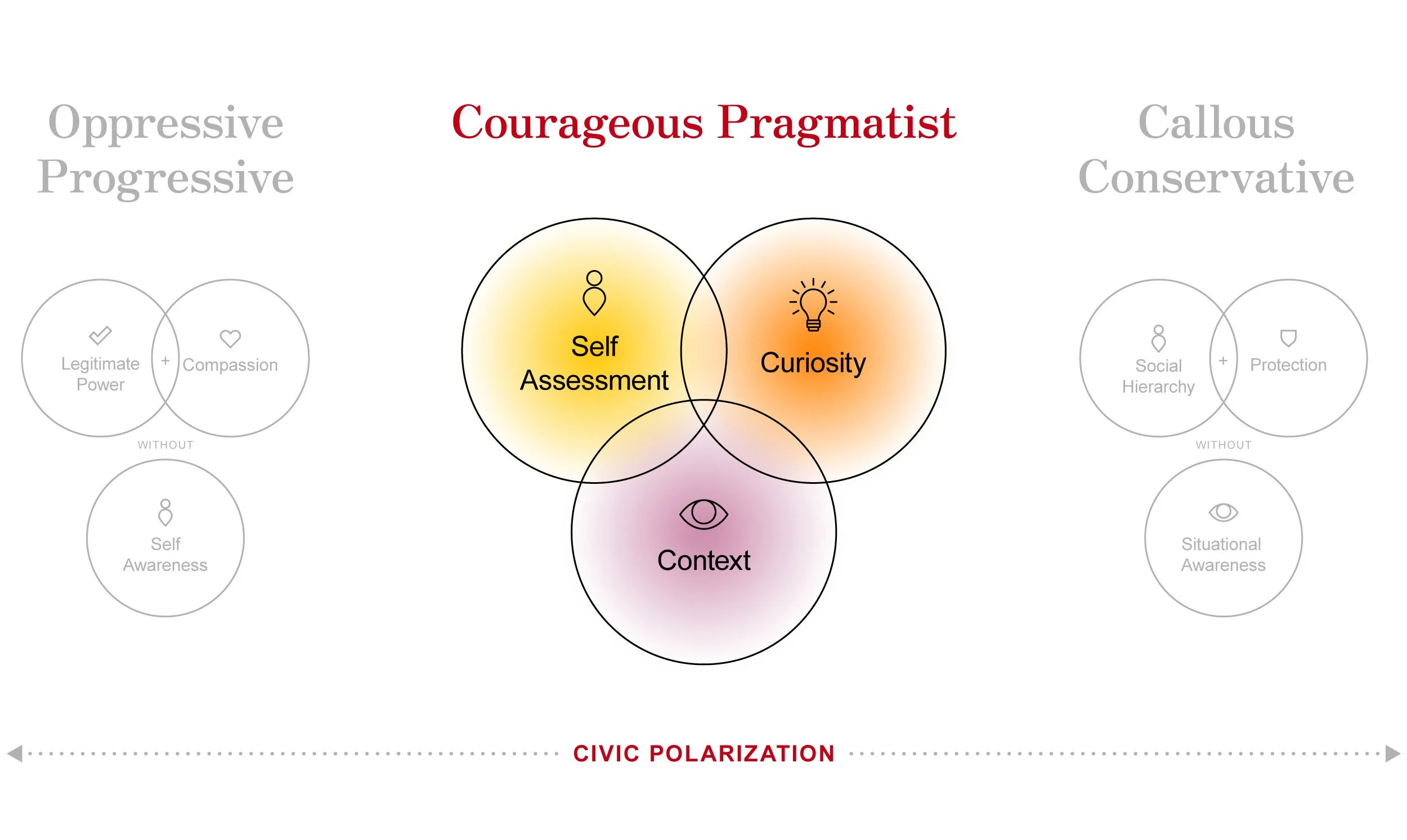
The Courageous Pragmatist
A focused and earnest self-assessment is essential to finding and minding the middle. And it is important to learn to observe what is, without judgment, when reflecting internally. Judgment may be accompanied by shame and guilt, which can result in projection, othering and the abdication of personal power. Judgment also very often leads to movement toward either side of polarization, in attempts to distance one’s self from discomfort.
Self-assessment begins with questions such as:
Where or how might I benefit from the very problem I’ve identified?
What is my relationship with or proximity to the identified problem’s solution?
What is it that I want to be true?
What power do I hold that can be leveraged to create my desired outcome? Hint: think beyond formal authority to include expertise and existing relationships.
Where do I possess/lack credibility or understanding?
Curiosity about the potential for aligned interests from unlikely allies is vital to avoiding the trap of civic polarization. Curiosity builds humility and signals an open stance, both of which support the cultivation of relationships that can be leveraged to affect change. In the middle, context is king. To understand context, we must be willing to ask ourselves and others why a problem exists and for whom it is most problematic. Moreover, the process to understand the context surrounding a problem or circumstance fosters empathy and effective collaboration.
The following questions serve as a good start to mapping context:
What factors and decisions worked to create a particular problem/circumstance?
Who is most affected by the identified problem/circumstance and what is the impact?
Whose perspectives have informed potential solutions to an identified problem?
What has been tried before and what was learned?
A courageous pragmatist is a person committed to assessing themself earnestly, leaning into curiosity and pursuing solutions or approaches that demonstrate a firm grasp on what’s real.
Finding and minding the middle also requires COURAGE. Courage is not the absence of fear, but action in spite of it. Looking at ourselves in the mirror and wrestling with the uncomfortable truths reflected back takes courage. Speaking up in the moment when you don’t have the perfect language, but recognize your power? Courage. Asking the question everyone else seems to already know the answer to, often requires courage. Calling someone in and having the hard conversation? Also courage. Courage is contagious. Courage emboldens us to take a risk or try a new thing that might mean messing up in front of others. Pursuit of solutions that do the most good for the most people instead of what’s popular or expected, most assuredly takes courage.
The truth is that none of the actions I just listed require a big title, lots of money or grandiose gestures. And yet, the belief that any or all of these things are necessary to shift the state of affairs in our workplaces, communities or across the country keeps many folks with worthwhile gifts or insights to contribute on the sidelines, waiting for someone else to say the hard thing or do the work they are uniquely positioned to do. I would argue that even though we see far too few examples of courage today on issues that define our nation, the potential for courageous action is infinite.
I often reflect on the example of that young woman who committed to doing what she could to break through the polarization she saw in her community, and how her courage fostered a reckoning of sorts among her neighbors. Following the task force’s final report, our state made historic investments to address the persistent crisis of housing and eventually created standalone legislative committees to focus on housing and homelessness prevention. I’d love to suggest that our research and the final report is what shifted the state’s posture, but I know better. I believe that the effort we made to capture the experiences and expertise of residents across the state led to different discussions with candidates on the doorsteps of likely voters during campaign season and created the political will to do better.
