
Minding the Middle: The Path to Courageous Pragmatism – Part 2
Extreme Measures
Much commotion has been made about the steep increase in affective polarization within the US. And, for good reason. The dislike and distrust that a growing number of people feel relative to opposing political parties can lead to less effective public policy due to political gridlock, greater income inequality, decreased economic stability, the erosion of social bonds, which give rise to cruelty and violence; the list goes on… In short, affective polarization has seen a marked increase–particularly over the last 5 years, and poses significant risk to our nation’s overall wellbeing.
I want to talk less about affective polarization though, and more about civic polarization-- especially what I have observed in my work to advance collective social impact and systems change. Civic polarization refers to the breakdown of civic engagement and trust within a society–beyond political affiliation. While the spectrum of civic polarization in some ways aligns with traditional political ideology, it is far more complicated when we also account for the ways dynamics such as race, socioeconomic status and gender inform our identities and views in this country. Civic polarization is not as neat as how one votes, but more nuanced because it captures how we are in relationship with each other and ourselves. If civics is the study of the rights, duties, and responsibilities of citizens in a society, with a particular focus on how government functions and how citizens can participate in it, then I see civic polarization as a signal about the state of our democracy.
In “...fear, itself,” I identified polarization as a manifestation of fear, specifically the fear of losing one's voice, or sense of control. I believe civic polarization stems from the fear of losing control over how resources are distributed. When I say resources, I’m referring to tangible things–like money, food or housing. I’m also talking about intangible things, such as opportunity and choice.
Similarities between extremes
While the nature of polarization suggests vastly different views, there are some similar traits between extremes on either side of the spectrum.
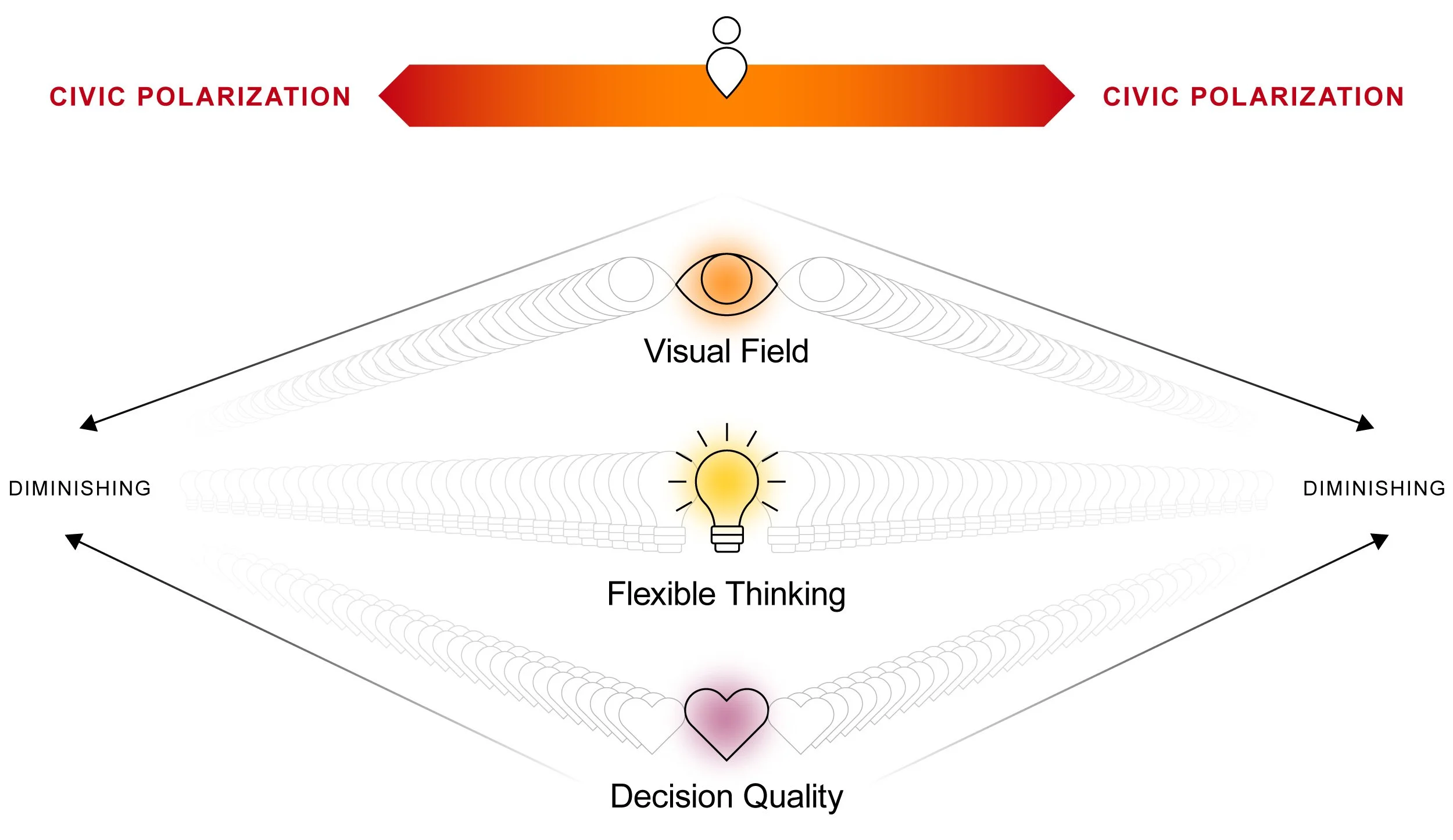
Imagine if you will, a straight line representing a spectrum of civic polarization, with arrows on either end, pointing in opposite directions. What I have observed in my work with people and groups from various walks of life, is that the farther a person travels in either direction from the center, they express less flexible thinking, produce poorer decision quality and demonstrate a more narrow visual field.
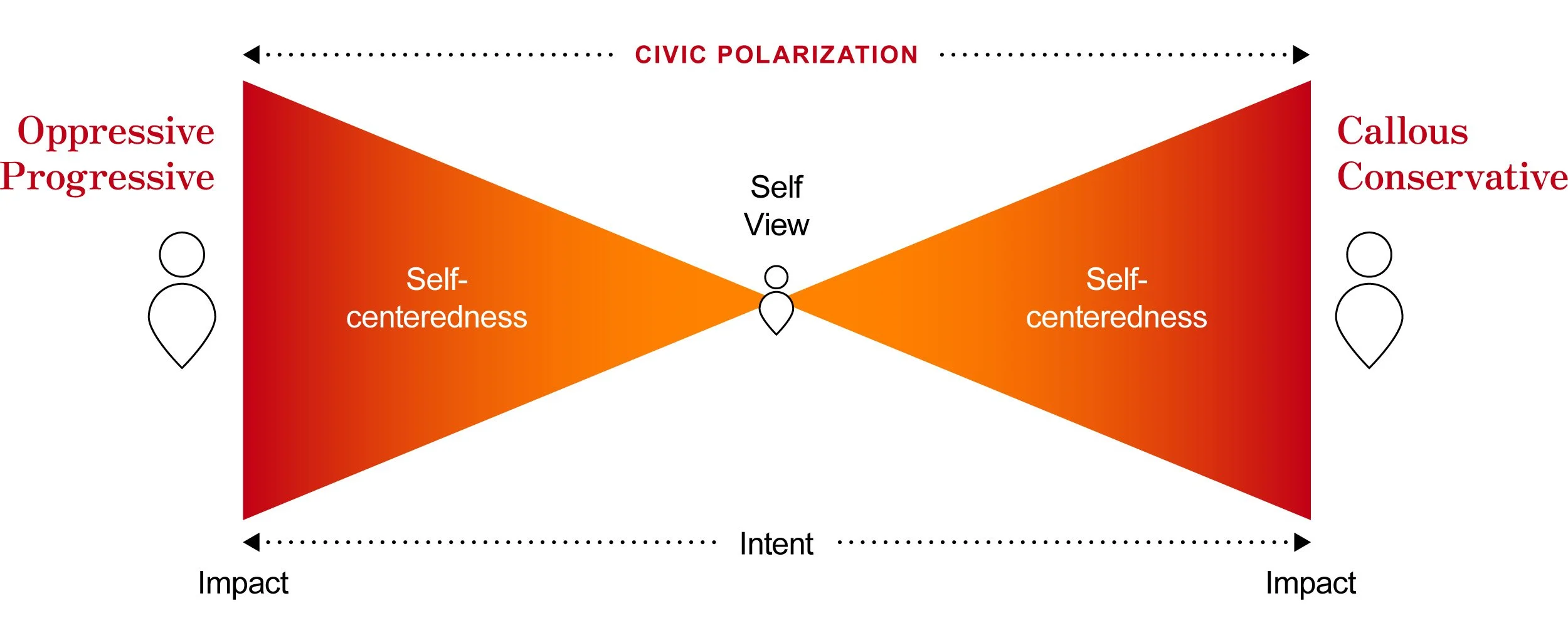
Along that same path toward polarization in either direction, I’ve also observed an increased prioritization of self-interest, a widening gap between one’s intent and their impact, as well as a greater likelihood of zero-sum problem and solution framing.
If you believe, as I do, that polarization is the manifestation of fear of losing control, then a logical expectation is for people to work to mitigate this fear. A consistent approach to (re)gaining control on either end of the spectrum in the case of civic polarization, is the use of coercion, censorship and othering. Coercion is the practice of compelling someone to do something through threat of punishment or negative consequences. While a form of power, coercion produces the least durable results. Censorship refers to the suppression or prohibition of any speech, books, news, etc. that are considered obscene, politically unacceptable, or a threat to security. Othering, the view or treatment of people as intrinsically different from oneself, is quite often a tool of avoidance. By othering, one is able to distract from ways they may benefit from or be complicit with a particular challenge.
Picking Sides
For the purposes of simplicity, I will speak to civic polarization in terms of left and right. I’ve identified the essential elements of my framework, in alignment with aspects of our being affected by fear: focus, motivation, visual field and tactics. It is worth mentioning, however, that continued movement toward either direction is likely to land a person on the other side of this spectrum.
On the Left
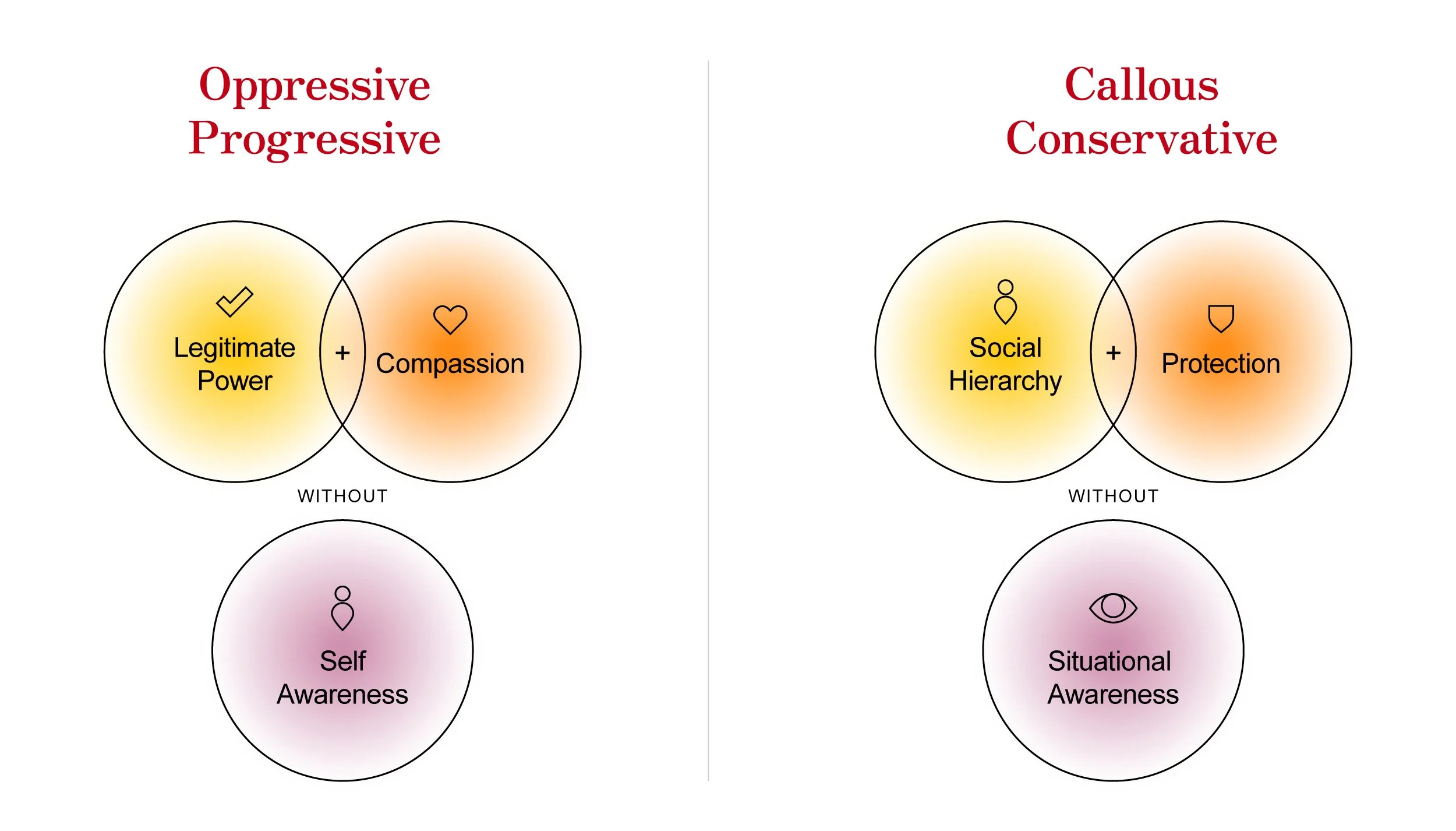
At the extreme left, I often observe a focus on legitimate power– the ability to act or produce a desired result as a result of a person’s title or position within an organization. Legitimate power serves as a social contract in some ways, as it relies on the compliance of others to exercise authority.
I find the motivation of people polarized along the left side of the spectrum to be a desire to alleviate pain and suffering, driven by sympathy. Compassion. As a general concept, compassion is well-intentioned. In the extreme, absent self-awareness, compassion may actually create harm or hold social challenges in place. Self-awareness refers to the conscious knowledge of one’s motives and the ability to notice your strengths and challenges. When an extreme focus on legitimate power is combined with compassion but lacking self-awareness, you get the oppressive progressive.
On the Right
At the extreme right, I have observed a focus on social hierarchy, the stratified ranking of a society’s members according to their relative power, status or importance. In a social hierarchy, power, status and importance are conferred and reinforced by societal views on factors such as race, gender or social class.
My observation has been that people polarized along the right side of the civic polarization spectrum are motivated to protect the existing system of stratification within American society. The motivation to protect one’s ability to live comfortably within society or aspire toward that end is a deeply human one. Taken to the extreme, however, this motivation may lead to the insensitive regard for the wellbeing of others, especially in the absence of situational awareness. Situational awareness is the ability to fully understand one’s environment, effectively assess threats and make informed decisions. When an extreme focus on protecting existing social hierarchy is paired with the absence of situational awareness, you get the callous conservative.
Two Extremes of Civic Polarization
Having shared words and concepts to explain the world around us better facilitates forward movement and collaboration. My goal in sharing this framework is to add language to what so many are feeling and navigating in the work to ensure our communities, workplaces and government operate effectively for as many of our neighbors, colleagues, friends and family members as possible. While prevalent, civic polarization is not inevitable. There is another component of this framework.
